Yamaha
V-Max Gallery
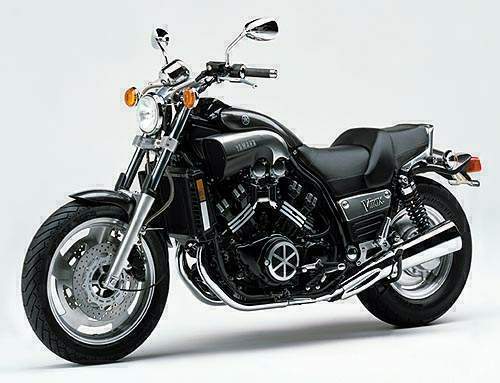
Yamaha's V-Max
is designed to excel in the acceleration field.
Its top speed of around 135mph is not as high
as it might be, given a monstrous V4 engine
with a power output of 135bhp, and compared
with race-replica models. What is sensational
is how quickly it gets to that speed. Acceleration
is the V-Max's reason for being, helped by the
fat rear tyre (150/90 x 15) like that of a drag
bike and gearing to match.
Launched in 1984, the V-Max became at once
the ultimate hot rod, the fastest-accelerating
road bike ever, sizzling through the standing
quarter mile in not quite ten seconds. Ten years
before, only specialized dragsters could accelerate
like that.
The basis of this factory hot rod was the big
V4 engine from Yamaha's Venture tourer - a veritable
river-barge of a bike, festooned with fairings
and luggage gear. All that went, and the V-Max
was left behind, spare but still monstrous,
its styling dominated by the massive engine
with two giant air-scoops for the four down-draught
carburettors where you would expect to see the
fuel tank. The V-Max, like the Venture, has
a low-slung tank beneath the seat, with the
fuel pumped up to the four greedy carburetor
throats.
| Bike |
Image |
Description |
Yamaha V-max |
 |
Engine - 1198cc liquid-cooled
V4 four-stroke
Horsepower - 145bhp
Top Speed - 140 mph
Lanuched - 1985-2001 |
| 1984 Yamaha V-Max |
 |
Liquid cooled, four stroke, V-four, DOHC,
4 valve per cylinder. |
| 1985 Yamaha V-Max |
 |
Full power model, US import. |
| 1988 Yamaha V-Max |
 |
|
| 1989 Yamaha V-Max |
 |
One of motorcycling's legendary names,
the V-Max has become a byword for explosive
acceleration and power. First launched In
the USA in 1984 (it wasn't officially imported
to Britain until 1991) the V-Max quickly
established a reputation for scary power,
and equally scary handling. The engine had
immense power and torque, more than sufficient
to overcome the chassis and brakes. The
engine is a transverse V-four, 16-valve,
liquid-cooled design, with a unique intake
system. Over 6000rpm, valves open in the
inlet manifold, allowing each cylinder to
breathe through two carburettors rather
than one. This 'V-Boost' system supplies
an extra burst of power and torque, transforming
the V-Max into a screaming drag-racer, and
boosting the maximum power to 104kW (140bhp),
amazing performance for an early 1980s design. |
| 1993 Yamaha V-Max |
 |
Liquid cooled, four stroke, V-four, DOHC,
4 valve per cylinder. Legendary for its
acceleration off the line, the original
V-Max has earned its cult following. Macho
looks and a monster V4 engine says this
bike means business. |
| 1999 Yamaha V-Max 1200 |
 |
A small manifold-type connecting passage
links each pair of left and right carburetors.
A butterfly valve in the center of the passage
remains closed below 6.000rpm, and each
cylinder fills normally through a single
35mm carb. The magic begins at 6.000rpm,
when the microprocessor-controlled servomotor
begins to open the butterfly valve until
its fully open at 8.000rpm. V-boost simply
forces one cylinder to fill with a mix from
2 carbs. This simple supercharging effect
is seen clearly on the dyno, where the Vmax
power curve literally gets a second wind.
It catches the motor right at its torque
peak and carries it all the way to its 113.5
rearwheel hp peak. |
| 2005 Yamaha V-Max |
 |
20th Anniversary Limited Edition.
Liquid cooled, four stroke, 70° V-four,
DOHC, 4 valve per cylinder.
|
The V-Max's extreme
power would be enough to overwhelm some modern
sportsbike chassis, but in a 1980s custom chassis
it can be truly scary for the rider. The front
disc brakes lack both power and feel while the
narrow front forks and unsophisticated twin
rear shocks quickly lose control of wheel movement
in fast corners.
The double cradle steel-tube frame is too weak
to handle all the power, and chassis flex further
upsets cornering, causing wallow and weave whenever
the pace is raised. Stronger brakes were fitted
in 1993, but made little difference to the V-Max's
chassis performance.
But in a straight line, the V-Max is an awesome
performer, with enough power to spin its wide
150-section rear tyre away from a standing start.
A five-speed gearbox and heavy-duty shaft final
drive get the power from the engine to the cast
aluminium rear wheel.
The design of the V-Max is unconventional in
many ways. The fuel tank lives under the seat,
and access is via a flap in the seat. An instrument
console mounted on the dummy fuel tank houses
the tacho, temperature gauge and indicator lights,
while the chrome-plated speedo is mounted above
the headlight.
Please e-mail the webmaster if
you have a picture worth adding to our database,
e-mail: webmaster@motorbike-search-engine.co.uk
|