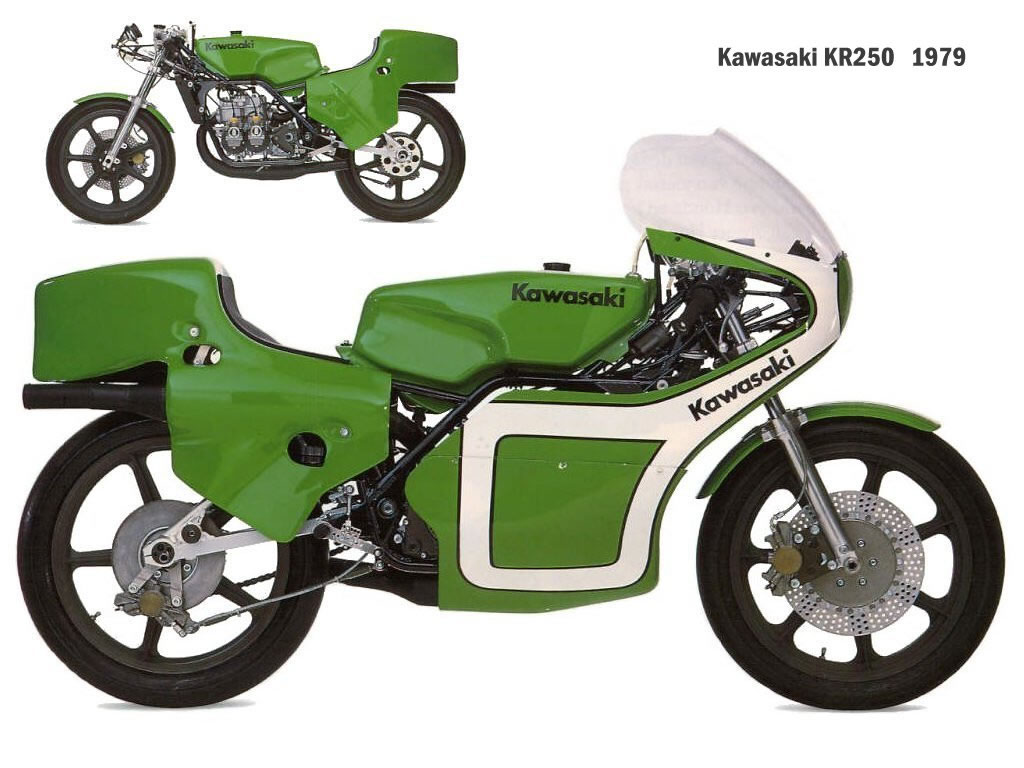
Kawasaki KR250 History
 
Kawasaki's in road-racing go all the way back to
1965 with Dave Simmonds on a 125cc watercooled disc-valve
twin. This may seem faintly exotic bearing in mind
the basic aircooled piston-ported road bikes of the
time but in 1967 a watercooled V4 125 (the 'KR-3')
was experimented with. Dave won the 125cc World Championship
for Kawasaki in 1969 and later campaigned the 250
(A1-R) and 350 (A7-R) aircooled twins. Throughout
the 70's, riders like Ginger Molloy, Yvon DuHamel
and Barry Ditchburn raced the 500 (H1-R) and 750 (H2-R)
aircooled triples with great success and these were
subsequently developed and watercooled to create the
H1-RW and the mental KR750 as raced by such riders
as Gary Nixon, Paul Smart and Mick Grant. With a view
to capturing the last-ever Formula 750 World Championship,
an experimental trapezoid '602S' (think normal inline-four
but with the outer cylinders offset forward) was tested
in 1978 by Gregg Hansford but abandoned shortly afterwards
without being raced.
In 1978 and 1979, Kork Ballington won the World 250cc
& 350cc Grand Prix Championships for Kawasaki
on disc-valve watercooled tandem-twins. In 1980 and
1981, Anton Mang repeated the same success. The bikes
were designated KR250/KR350 and utilised the latest
in chassis and engine technology. One of the benefits
of the tandem-twin design was a much slimmer engine
allowing improved aerodynamics. First appearing in
1975, each cylinder had a separate crank and though
initially phased at 180º, were later retimed
to 360º to prevent vibration and give more power.
As well as Grands Prix, the bikes were raced in the
US AMA series, British and Australian Championships
and the TT. The KR250's first GP entry at Hockenheim
in 1977 saw Akihiro Kiyohara miss out on a debut win
by only 0.1 second. Mick Grant took it to its first
GP win at Assen a few weeks later. In 1978, the KR350
was introduced and the Kawasaki UK team managed by
Stan Shenton and Ken Suzuki pitted Ballington and
Grant against Hansford on a Kawasaki Australia KR
in both classes and Mang on a 250. Each team gave
much credit to its race technicians, Kork in particular
attributing a great part of his success to the tuning
skills of his mechanic brother Dozy.
In 1980 Kawasaki released the square-four (twin-crank)
KR500, the engine looking much like two 250's side
by side but the chassis being an unusual semi-monocoque
design. It was shelved after the 1982 Grand Prix season
following poor results, followed a year later by it's
much-more-successful little brother. In 1989 Kawasaki
made a brief return to racing two-strokes with a new
experimental reed-valve upside-down V-twin 250 (the
'X-09') complete with KIPS powervalve system. It was
tested in Japan that year but did not re-appear until
Daytona in 1992, raced by Aaron Slight and Trevor
Crookes in a team managed by Kork Ballington, who
also acted as development rider. Despite a capable
chassis, the radical engine design proved too troublesome
and competitive power was never achieved.
Of course, Kawasaki has successfully raced four-stroke
engined bikes in various classes over the years. From
the Z1-based racers of 1973 with Christian Leon and
Jean-François Baldé, through the Godier/Genoud
endurance bikes and Eddie Lawson's iconic Z1000R Superbike,
right up to the 750cc endurance bikes and Scott Russell's
WSB ZXR-7, there's always been a splash of lime-green
somewhere near the front of the grid. And now of course,
with the switch from 2 to 4 stroke in MotoGP, Kawasaki's
back once again in the premier class. Though let's
face it, if you're reading this, like me you're not
really interested in the 'diesels'...
Some of the old race bikes still exist in museums
and private collections around the world and ocassionally
come up for auction - you'd better have deep pockets
though ! They sometimes get a run out at events like
the Goodwood Festival Of Speed and the Montlhery Coupes
Moto Legende in France and some are even still raced
properly in classic events. The pictures below show
journalist Chris Pearson testing Kork's 500 for an
article in the Feb 2005 issue of Classic Mechanics
magazine. Now how do you get a job like that ?...
|